Author: Mikko Erola, Account Director / Team LeadPublished Updated 5 min read

Continuous development of the web service ensures that the donation flow stays optimised and technically up to date. This prevents donors from dropping off along the way.
Case: World Vision
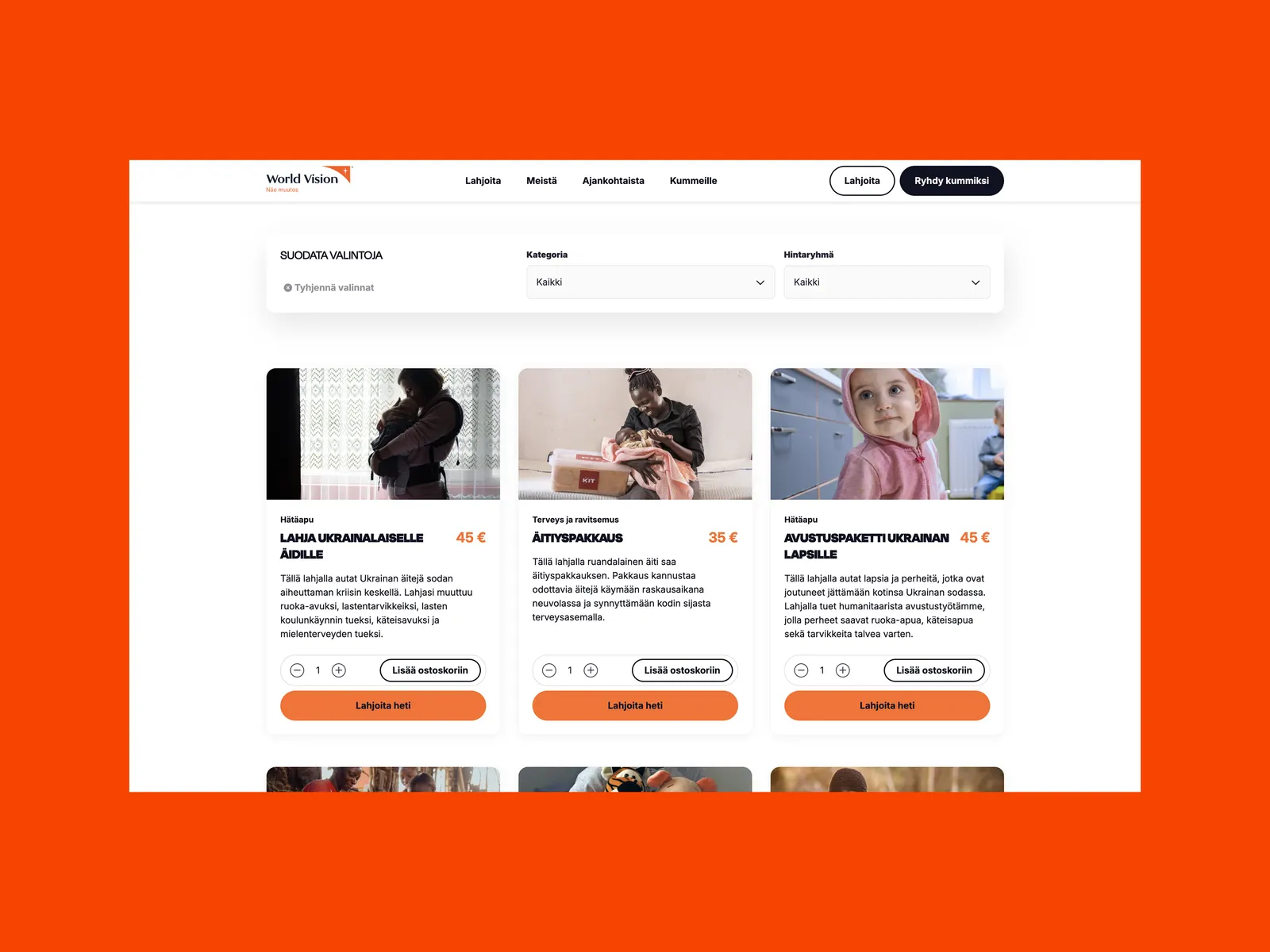
We built a web store for intangible gifts for World Vision. Donors can buy items such as school supplies or farming tools, which are then directed to aid projects.
A simple shopping experience and clear gift categories significantly increase the conversion rate.
World Vision (opens in a new tab)
Success factors in fundraising web services
The best solutions for fundraising services – both in user interface and in technology – follow the same principles as successful online services in general.
Donors expect:
- Clear and consistent user and donation paths
- Technical reliability and accessibility
- A stylish and trustworthy interface
However, fundraising has a few unique aspects that require extra attention. Donors give money without receiving a direct return, trusting that the funds will be used for a good cause. Cases of misuse in the media have made donors more cautious and critical.
How fundraising web services lose user trust
Suspicious payment integrations and redirects
A payment process that suddenly takes the donor to an external page with a different visual style, without clear explanation, can raise doubts.
Unclear or incomplete description of how funds are used
Donors need to understand what their money supports or where it goes.
Complicated donation flow
Too many poorly indicated steps, unclear forms, hidden buttons, and functional bugs drive donors away.
Lack of transparency on real impact
Donors want to read concrete stories about how their donation has helped someone in need. Without this, motivation for repeat donations decreases.
Poor accessibility and mobile experience
In fundraising, mobile-friendliness and smooth usability are especially important, since donation flows are often more complex than a basic shopping cart checkout.
The role of content
The success of a fundraising web service also depends on how its content and navigation are built. Donors should easily find different ways to participate and get enough information to support their decision.
We often say – deliberately simplified – that even the best website or web store is useless if the content is poor. In fundraising services, this is even more critical, because there is usually a lot of content and multiple donation models:
- One-time donations
- Monthly donations
- Gift shops and intangible gifts
- Donations directed to specific projects or countries
- Donations as an individual or as a company
- …and so on.
Case: Fida
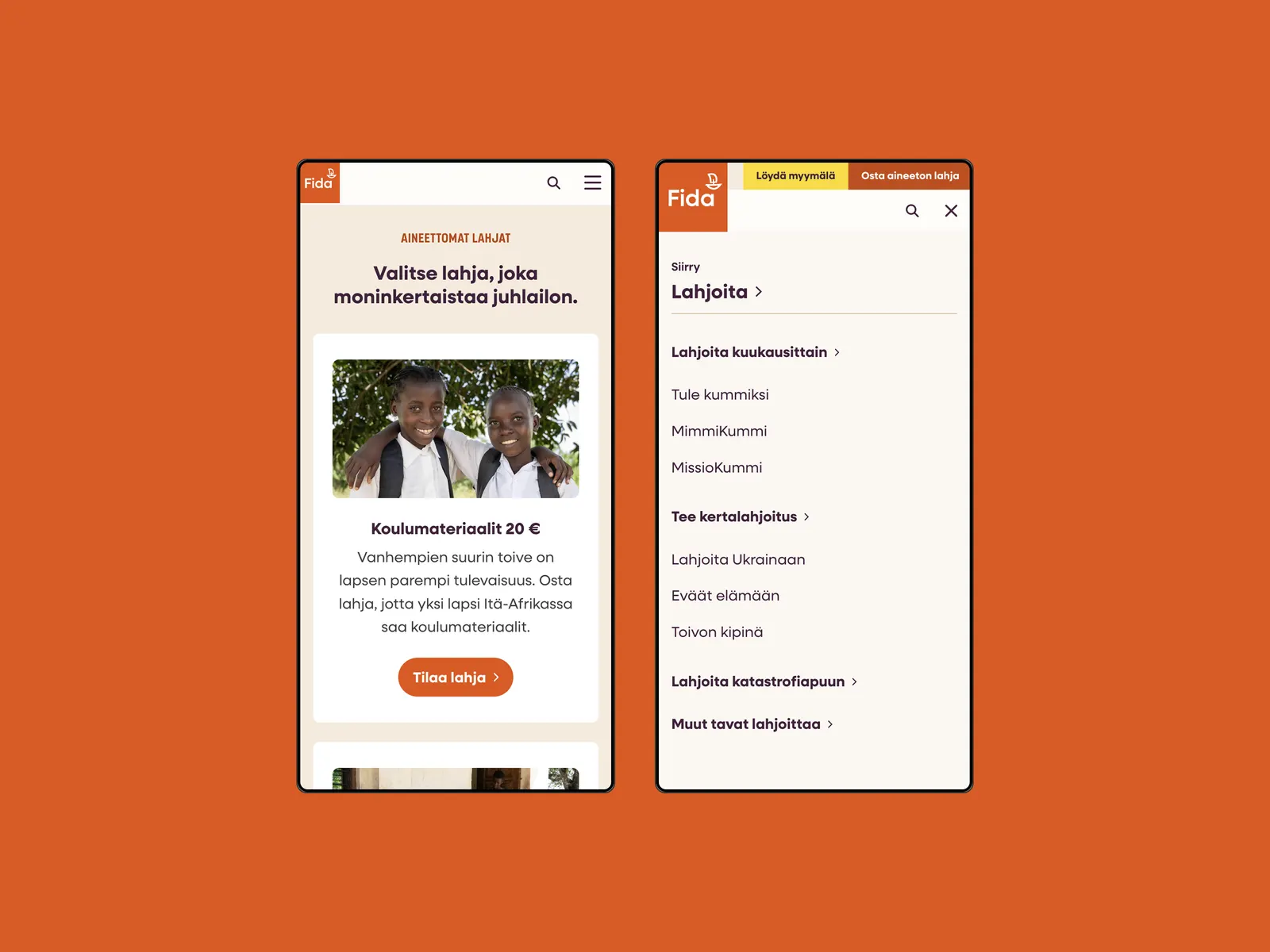
In Fida’s website, donating is made simple right from the main menu. The site structure guides users directly to different donation options, and the content is clearly grouped around specific needs.
This way, users can quickly find the donation method that suits them best.
Backend systems enable fundraising success
An online fundraising website should be built on a proven and reliable technical setup:
- Content management system**:** e.g. WordPress
- Product and payment logic: e.g. WooCommerce (for intangible gift shops)
- Customer relationship management (CRM): e.g. Salesforce
- Payment gateways: Wide range of payment methods, especially MobilePay and online banking
- Advanced form features: Easy, clear, and versatile donation forms
When these parts work together, the donation flow stays fast, secure and reliable. Special attention should be paid to how data moves between systems and where each type of data is managed to keep processes smooth.
CRM at the core of fundraising
Many foundations and associations struggle with fragmented systems. Donations, invoicing and customer data are managed in separate tools, which increases errors and manual work.
A common solution is a CRM. When processes are built on the platform’s own features, operations remain reliable and cost-efficient.
Alternatively, donation management can also be built into WordPress. However, since WordPress is primarily a content management system, it lacks CRM capabilities. This raises costs and makes maintenance more complex.
When CRM is at the core, more time is freed up for what matters most: developing fundraising itself.
Case: Plan
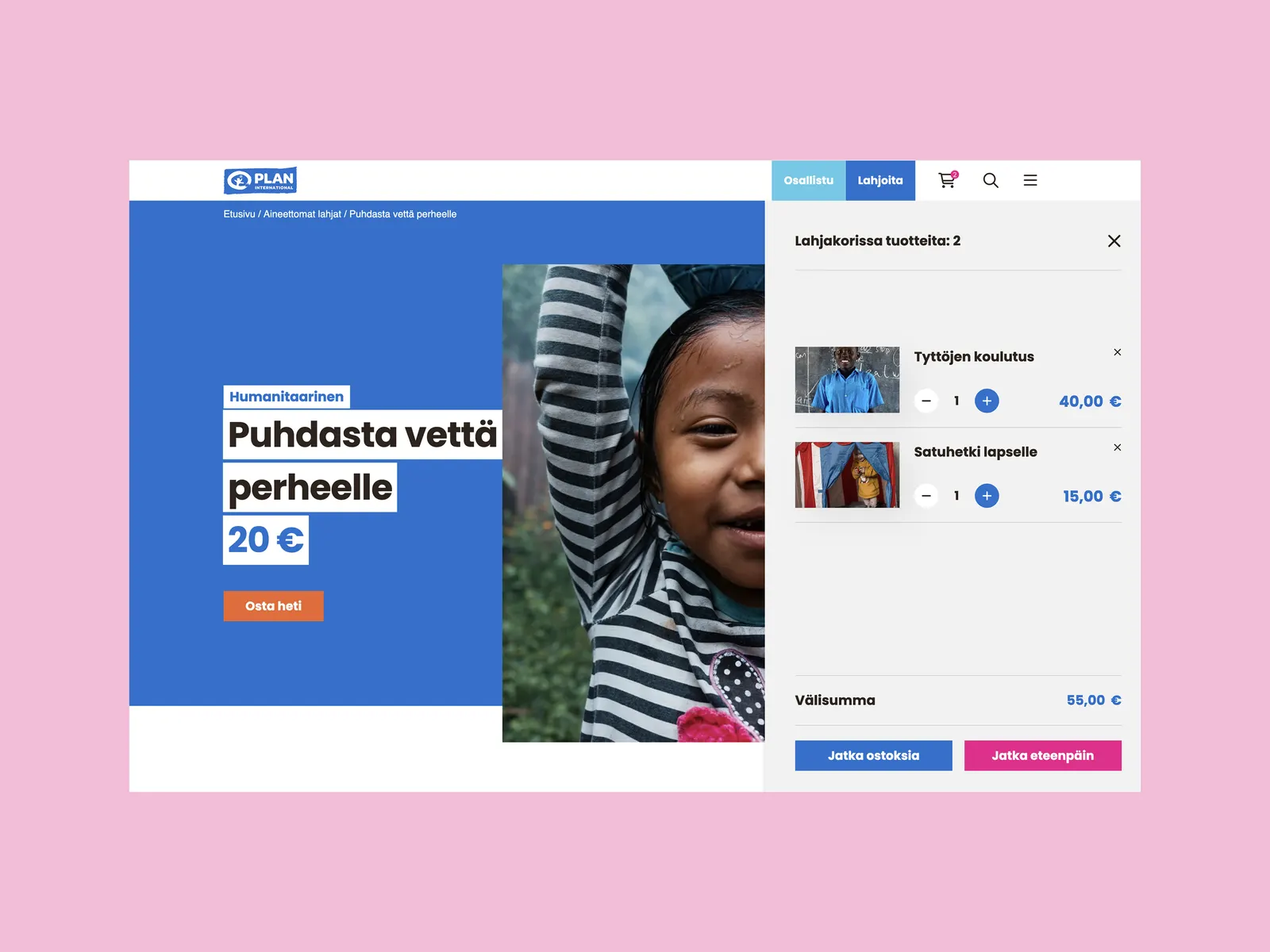
The Plan.fi (opens in a new tab) website is an excellent example of a well-structured fundraising service. The backend includes WordPress for content management, WooCommerce for the intangible gift shop, seamless CRM integration, and versatile payment gateways – including MobilePay, which has become especially popular for monthly donations.
MobilePay and monthly donations – a modern solution
MobilePay is a popular payment method in Finland and Denmark. Since 2022, MobilePay and Norway’s Vipps have operated under the joint Vipps MobilePay brand, making it one of the largest mobile payment services in the Nordics.
The latest innovation in MobilePay is recurring monthly donations. With this solution, setting up monthly giving does not require long forms or complex data entry – it’s quick and seamless.
Key benefits of MobilePay for organizations
- No extra setup costs: no monthly or start-up fees – costs apply only to transactions
- Real-time reporting: donation data is immediately available in MobilePay’s merchant portal, including donor names, phone numbers, reports, and analytics
- Reaching younger audiences: more than 80% of 18–40-year-olds use MobilePay, which lowers their threshold to become monthly donors
Case: Finn Church Aid (FCA)
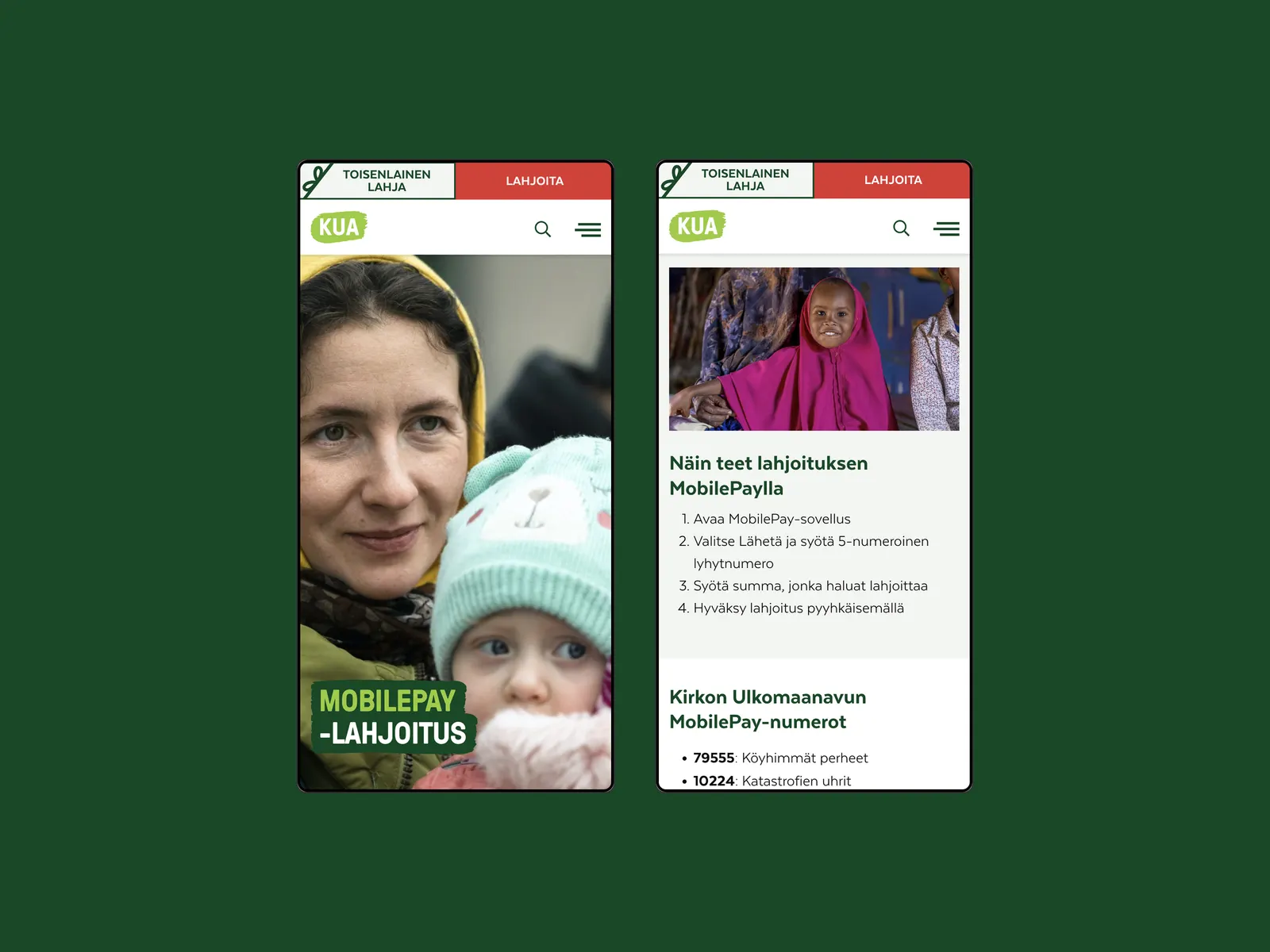
Our long-term client Finn Church Aid (FCA) uses MobilePay donations to help the poorest families escape extreme poverty and to support victims of disasters with essentials such as food, clean water and shelter.
Finn Church Aid website (opens in a new tab)
Continuous development based on analytics
Donor behavior in the website shows clearly what works and where bottlenecks appear.
It is important to identify:
- Where does the donation path break?
- Which types of content convert best into donations?
- How many donors return or become monthly donors?
Without data from analytics, these answers remain guesswork. With tools such as Google Analytics 4, heatmaps, and A/B testing, it’s possible to see where users drop off, which buttons they click, and which messages drive conversions.
Case: World Vision
By tracking World Vision’s donation flow with analytics, we found that over 30% of users abandoned the process at the payment stage. After clarifying the way payment options were displayed and highlighting MobilePay more visibly, conversion increased by 15%.
A fundraising website is never fully ready
A fundraising-focused website evolves with donor behavior, technology and competition. When the interface, content and technology work together, donations grow, and donor trust strengthens.
We are happy to support the development of digital fundraising. Shall we talk?
Article contents
- Why invest in digital fundraising?
- Success factors in fundraising web services
- How fundraising web services lose user trust
- The role of content
- Backend systems enable fundraising success
- MobilePay and monthly donations – a modern solution
- Continuous development based on analytics
- A fundraising website is never fully ready
Read more
All articlesBlog
Cybersecurity: The NIS2 Directive Takes Effect in Finland
On April 8, 2025, a new cybersecurity law came into effect in Finland, bringing major changes for hundreds of organisations. This is the national implementation of the EU’s NIS2 Directive. And yes, it may apply to your organisation as well.
15 May 2025 · 3 min read
Blog
The EU and UX Dark Patterns – Manipulative Design Practices Under Regulation
“UX dark pattern” refers to a manipulative design practice within a digital service’s user interface. Like accessibility and cybersecurity, these design practices have become a focus of EU regulation. The regulation addresses how websites and applications may guide users in unethical ways. The goal is to protect the user’s sense of autonomy when using online services.
15 May 2025 · 3 min read
Blog
Research Findings – WordPress as an Enterprise Web Platform
The State of Enterprise WordPress Survey 2024 highlights how large-scale organizations leverage WordPress to achieve their business objectives. For those of us who primarily use WordPress as a content management system, the results are no surprise—we are well aware of its capabilities. However, for those considering their platform options, these findings will hopefully lower the threshold for choosing WordPress even further.
20 Feb 2025 · 1 min read