Updated
Integrations and APIs, so your web service talks to your systems
An integration moves data between a web service and other systems, such as your checkout, customer, payment and ERP systems. We design and build integrations at a fixed price agreed after the definition. After launch, Care (Huolenpito) keeps them working. The price depends on what data moves and in which direction.
Get a priceTell us what you need
- Over 200 clients
- customer satisfaction
- Over 30 employees
Updated
Do you recognise these situations?
A web service is rarely alone. It needs data from other systems and gives data to them. Where the link is missing, a person moves the data by hand. These five situations are common:
- Orders or enquiries are keyed by hand into another system.
- Prices and stock levels are not up to date online.
- Customer data is scattered, and what the web service collects never reaches the customer register.
- An update to another system breaks the link, and nobody knows who will fix it.
- Error situations in the integration are handled poorly or not at all.
Where integrations are needed
Different systems serve different needs. An integration connects them so that data moves in the right direction.
| System | What moves | What it achieves |
|---|---|---|
| Checkout system | Prices, stock levels and orders | Shop and store show the same situation |
| Customer and membership system | Enquiries, applications and customer data | Data goes straight to sales or member services |
| Payment service | Payments and confirmations | Payment is handled as part of buying |
| ERP system | Products, orders and invoicing data | Nothing is entered twice |
What integration work includes
Definition
We start with the definition. We find out what data moves, in which direction and how often. We also check the other system’s interface and what it costs. The result is a fixed price.
Build and testing
We build the integration to the agreed definition and test it with real data before launch. You take part in the testing, because you know the data and processes best.

The Lindroos webshop has a broad two-way integration with the checkout system.
Monitoring and Care
An integration is a living part of the service. The other system changes, and the link can break. After launch we monitor integrations as part of Care and fix problems.
Third-party interfaces
The supplier of the other system decides about its own interface. We find this out in the definition, so you know the total cost before the build starts.
What the price depends on
Integrations usually cost EUR 3,000–20,000 excl. VAT. We agree a fixed price after the definition, because we define each integration separately. These factors affect it:
- quality of the data to move
- direction, one-way or two-way
- number of integrations
- quality of the other system’s interface
- possible costs from third parties
- material needed for testing
After launch, integrations belong to Care, a fixed monthly price. Further development is a separate optional agreement.
How a project goes
Each phase brings in its own area of expertise. The colour shows which one.
Kickoff
We agree goals and responsibilities.
Strategy
Definition
Data, direction and interfaces are written down. The result is a fixed price.
Service designData and analytics
Technical build
We build the integration to the agreed definition.
Software development
Testing with real data
Together with you, we test that the data moves correctly.
Software developmentData and analytics
Launch and Care
We launch the integration. After that, monitoring and fixes belong to Care.
Care
Every project includes, for example, proactive project management, workshops, reviews, weekly meetings and user guides.
Cybersecurity: The NIS2 Directive Takes Effect in Finland
Blog· 3 min read

Mikko Erola
Account Director / Team Lead
Tell us which systems you want to connect. We will get back to you by the next working day at the latest.
Integrations usually cost EUR 3,000–20,000 excl. VAT
We agree a fixed price after the definition. It depends on the data, its direction and the interfaces of the systems.
Integration references
See all workLindroos
Founded in 1878, Lindroos is a family-owned company and reseller in the watch and jewelry industry. Its flagship store has been located on Aleksanterinkatu in Helsinki since 1890. In addition, Lindroos operates two stores at Helsinki-Vantaa Airport and three others in downtown Helsinki. Our task was to design and implement a globally accessible online store that complements the physical stores, enhancing the brand’s customer experience comprehensively.
Suomalainen työ
The Association for Finnish Work became Finnish Work. When the Finnish Work brand identity was updated, it was also time for the website to better serve current and potential members, as well as other target audiences. The website is the organisation’s most important tool for marketing communications, information sharing, and member acquisition.
Ensi- ja turvakotien liitto
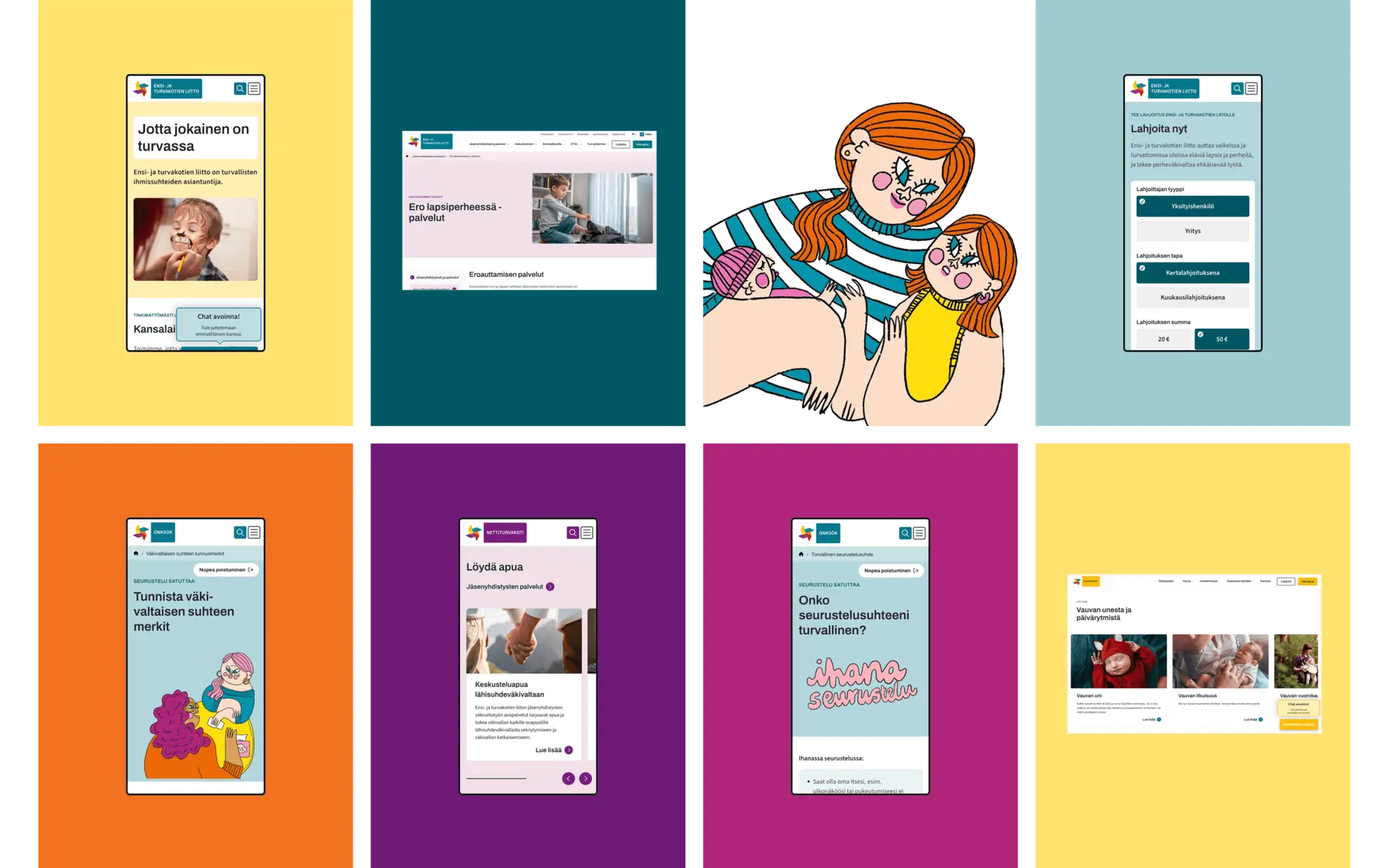
Ensi- ja turvakotien liitto (ETKL) now has a set of web services that improves how people find information and help, and makes its online communication more visible. ETKL is an expert in safe relationships. Our collaboration began in summer 2024. We designed and built the main site, the theme sites and the association sites, and the work continues as Care (Huolenpito).

Frequently asked questions
What does an integration mean?
An integration means that a web service and another system pass data to each other automatically. A webshop order can move to the finance system, or an enquiry from a form to the customer system. That way the same data is not keyed in twice by hand. The interface, or API, is the channel the systems use to talk. Our glossary explains it further.
How much does an integration cost?
Integrations usually cost EUR 3,000–20,000 excl. VAT. We agree a fixed price after the definition, because we define each integration separately. It depends on the data that moves, the direction, the quality of the systems’ interfaces and whether the other party has to make changes. We tell you the total cost before we start the build.
Which systems can a web service connect to?
A web service can usually connect to systems that have an interface. Typical ones are a checkout system, a customer and marketing system, a payment service and an ERP system. We find out in the definition what your systems support. If there is no interface, we tell you honestly which options exist and what they would require. That is a realistic starting point.
What if another system’s supplier charges for the interface?
The supplier of the other system decides about its own interface and its price. We find this out in the definition. We tell you before the build starts what third-party work or use will cost. That way the total cost is known from the start, and costs do not arrive as a surprise during the build. This belongs in every definition.
Can an integration move data in both directions?
Yes. The Lindroos webshop has a broad two-way integration with the checkout system. The Suomalainen työ web service has a two-way CRM integration. We set the direction by where the data is created and where it is used. We agree it with you before the build, so the data does not travel the wrong way. The direction also affects the price.
What happens if an integration stops working?
Integrations belong to Care, so we monitor them after launch and fix problems. The cause is often a change in the other system. Support is typically available on weekdays from 8 to 17, and particularly critical problems are handled regardless of the time. Response times are set in the agreement. Further development is a separate optional agreement, and it keeps the whole working.
Can you build an integration for a service another supplier built?
Yes. In a takeover we take the service into care even if we did not build it, and documentation is not a precondition. After that we can build new integrations or fix old ones. For Berner we took dozens of existing web services into care, and building integrations is part of that collaboration whenever the need arises. That way the data moves correctly.
More webshop services
B2B webshop
A webshop for business customers: prices, orders and integrations.
B2C webshop
A webshop for consumers that sells on the busiest days too.
Webshop care
We look after your webshop so sales do not stop.


Read more on this
All articlesBlog
A Website is a Key Priority. Period.
A website is the most important single channel for marketing communication, sales, and recruitment for a B2B business. I’d dare say that 99% of potential customers and employees visit a website before making their decision — often before any first contact is even made. When this is the case, it should be a key priority. Right? CEOs, stay alert!
6 Sept 2024 · 3 min read
Blog
Why is Now The Perfect Time To Revamp Your Website, Not Later?
In today’s digital world, a website plays a bigger role in a company’s success than ever before. Users expect a smooth, modern experience matching the world’s best services. Given rapid technological advancements, evolving security threats, and changing search engine requirements, regularly updating your website has become essential. In this article, we explore why keeping your website up to date isn’t just a recommendation — it’s a must for staying competitive.
11 Dec 2024 · 2 min read