Author: Isto Karttunen, Senior Project Manager / Team LeadPublished Updated 2 min read

The change would force businesses to think about which data they really need.
Read more about manipulative design practices
EU regulation has also taken on other manipulative design practices in web service interfaces, the so-called “dark patterns”.
The aim of the regulation is to give users of digital services a stronger sense of autonomy.
The EU proposes browser-level consent. What does that mean?
With browser-level consent, users would manage how their data is used in one place, in the browser or another central management system. Websites would follow these settings automatically. According to the European Commission’s draft, the transition would happen by 2026.
In practice, we could say goodbye to cookie pop-ups. It would also lighten the technical and legal load on websites, as complicated consent systems would no longer be needed. The reform also proposes excluding statistical cookies, the ones that only collect anonymous visitor data, from the cookie requirements (Ecommerce News (opens in a new tab)).
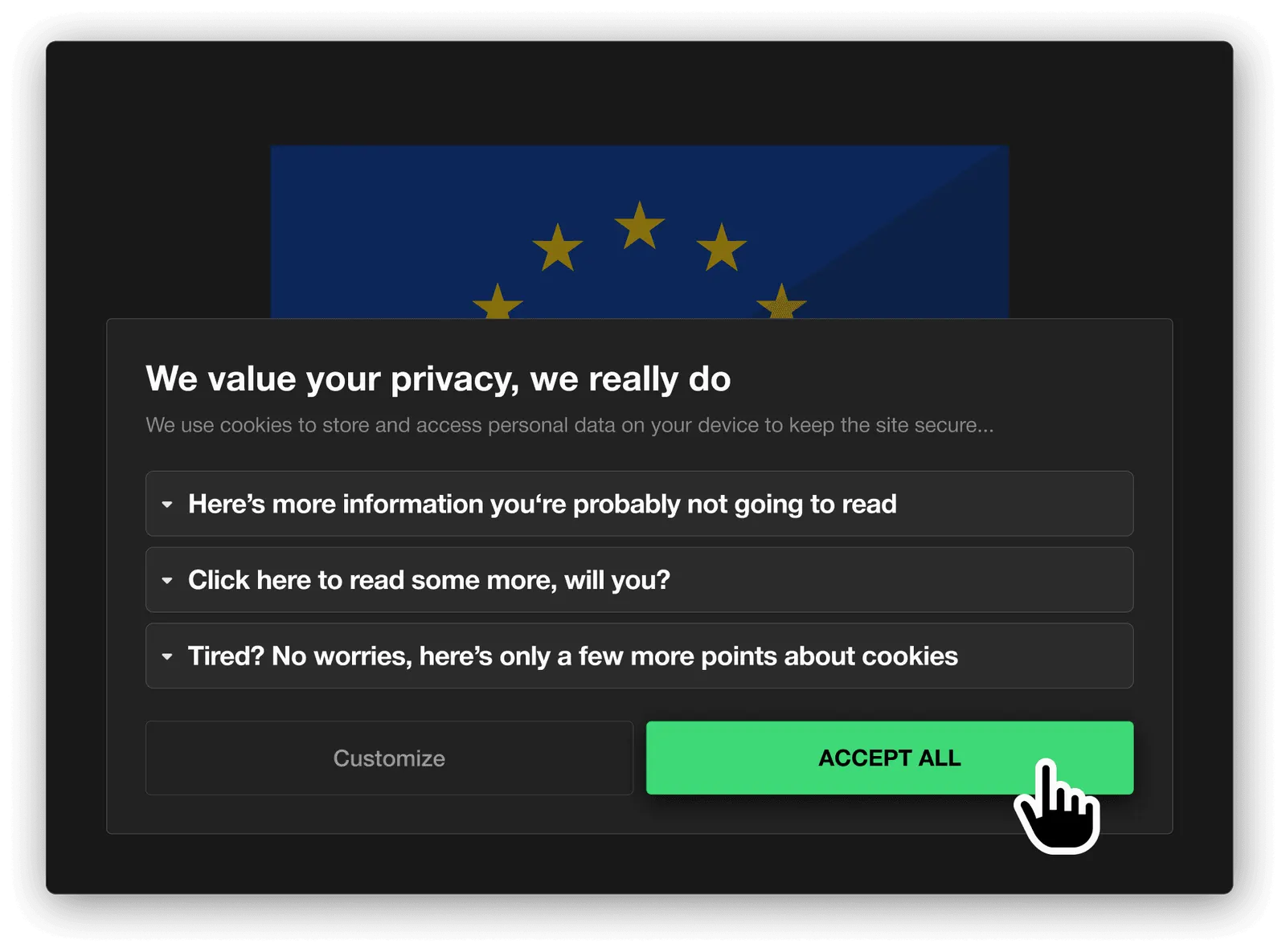
The current cookie requirements are a stumbling block for the user experience.
What began as an effort to protect users’ privacy has become a stumbling block for the user experience, and it causes frustration.
What can’t we answer yet?
The direction is clear, but some details are still open.
- Is browser-level consent enough to protect privacy?
- How do we make sure different browsers behave consistently?
- How will marketing and analytics tools adapt when consent is no longer asked site by site?
The change would force businesses to think about which data they really need.
Even so, the reform of the EU cookie directive signals change: more autonomy for users and more flexibility for businesses.
Read more
All articlesBlog
I built a website for five grand, but it would cost you 30 grand
We are one of Finland's leading WordPress agencies. Yet our new website does not contain a single line of WordPress. Most of the site was built by me, the CEO, and I can't code. In this article I explain what that proves and what it doesn't.
19 Nov 2026 · 8 min read
Blog
WordPress security vulnerabilities: what is actually going on?
July and August 2026 were a historically heavy stretch for the WordPress ecosystem. Within a couple of months we saw a critical vulnerability in WordPress core itself, more than a hundred plugin security fixes, an unpatched login bypass in a popular SSO plugin and a case where malicious code reached thousands of sites straight through the official plugin directory. The National Cyber Security Centre Finland at Traficom also issued its own warning. In this article we explain in plain language what happened, why and when.
17 Aug 2026 · 13 min read
Blog
The EU AI Act gets real: what does Article 50 mean in practice?
The EU AI Act has been talked about for a long time. Now it finally means something. And it means something for all of us who build or use AI-based digital services. On 2 August 2026, the Act's transparency obligations in Article 50 started to apply. In practice, they affect every organisation that uses AI in its website, online service or content.
9 Jun 2026 · 3 min read